
Physiotherapy for Parkinson’s Disease Delhi | Balance & Gait Rehab
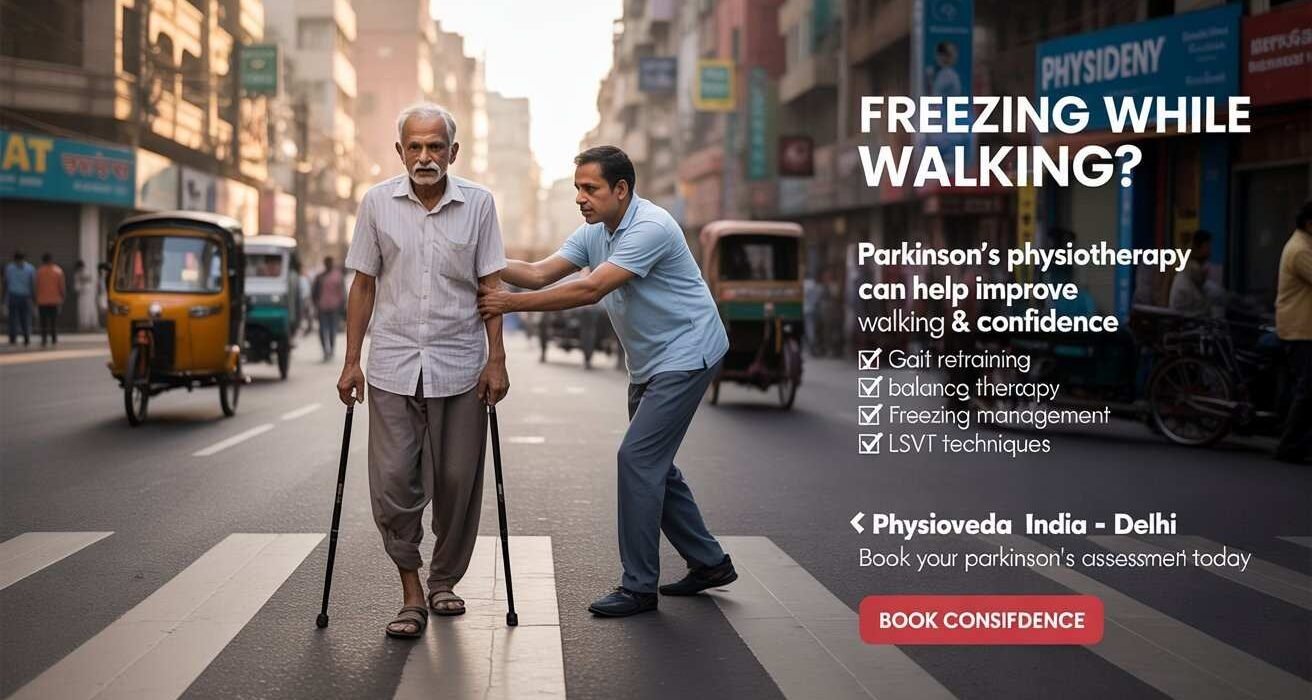
Imagine navigating a busy Delhi street with Parkinson’s – feet shuffling and suddenly freezing while crossing a road. This is all too real for many patients who fear falling or losing independence. Physiotherapy for Parkinson’s disease Delhi offers hope. At Physioveda, our expert team combines advanced gait and balance training with personalized care so patients regain movement and confidence. Many notice easier walking and steadier posture from the very first session as we focus on real functional improvements (not just exercises). Our Delhi clinic is dedicated to delivering evidence-based neurologic rehabilitation with an empathetic, hands-on approach.
Understanding How Physiotherapy for Parkinson's Disease Delhi Affects Movement
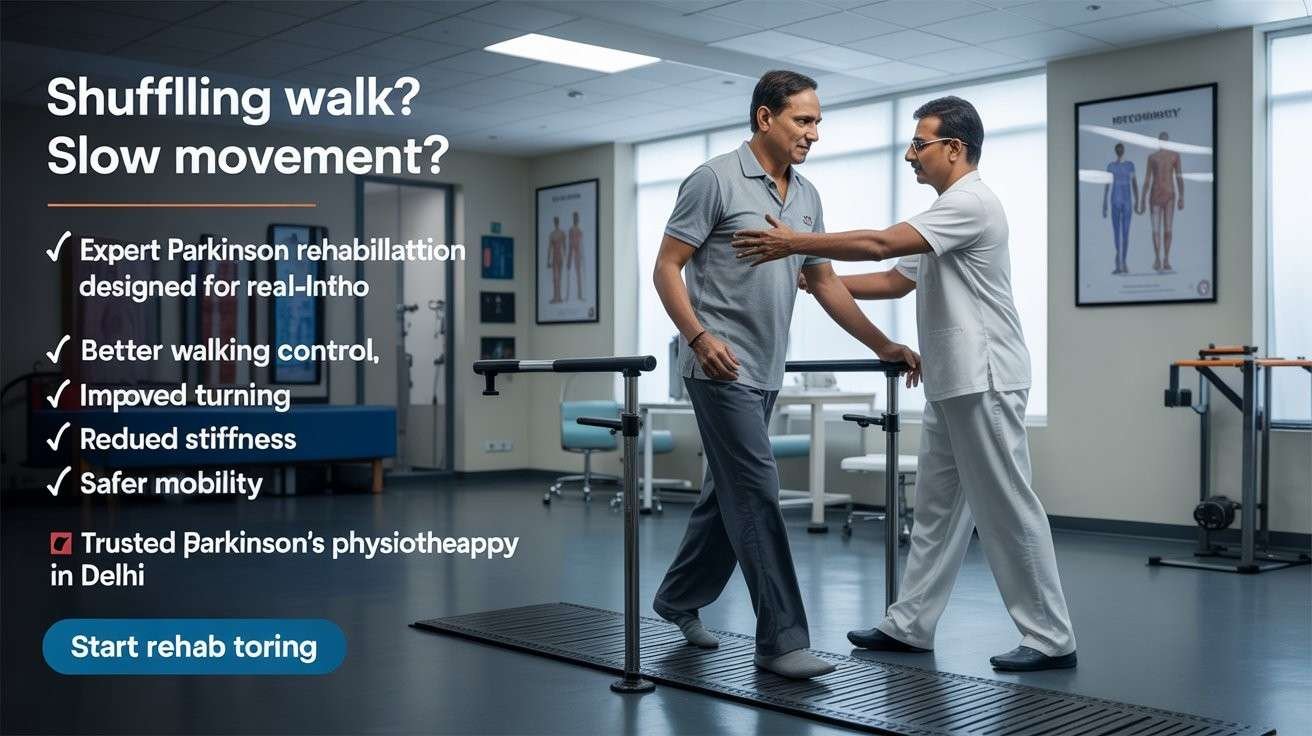
Physiotherapy for Parkinson’s Disease Delhi. Parkinson’s disease causes slowness (bradykinesia), stiffness (rigidity) and balance problems that change normal movement. Muscles may feel tense or “stuck,” making even daily tasks slow. Many people with PD develop a stooped, shuffling gait: steps become very small and quick (called festination), arm swing fades, and turning triggers hesitation or freezing. Patients often lean forward with a rounded back and head, which can reduce breathing and create neck/back pain. All these changes – plus the fear of falling – can seriously shrink one’s confidence and independence.
However, exercise and therapy can make a difference. Major PD foundations and research emphasize that exercise (including physiotherapy) improves gait and balance, and reduces falls. Early intervention is key: you don’t have to wait until severe problems occur to start therapy. At Physioveda, we help people move better from day one by counteracting these movement deficits with targeted training.
Detailed Movement Assessment – Foundation of Effective Physiotherapy for Parkinson Disease in Delhi

Physiotherapy for Parkinson’s Disease Delhi. Every patient’s movement pattern is unique. That’s why we begin with a thorough, person-centered assessment. We observe and measure key tasks and symptoms such as:
- Walking speed and stride length – Are steps very short or uneven?
- Shuffling gait or flat-footed steps – Is heel strike missing?
- Freezing episodes – Where and when do freezing blocks occur?
- Turning ability – Do turns cause hesitation or loss of balance?
- Posture – How stooped is the trunk and head? Any tilt?
- Arm swing – Is arm movement decreased when walking?
- Sit-to-stand ability – How easily does the patient rise from a chair?
- Balance and transfers – Can they stand on one leg, step in different directions, get on/off toilet or bed?
- Confidence and fear of falling – How does anxiety or off/on medication states affect movement?
We may use objective tests like the Timed Up & Go, Functional Gait Assessment or Berg Balance Scale to quantify abilities. As a guide on best practice notes, gait rehab should be “guided by a person-centred assessment” including goals and context. We also consider on/off medication phases and freezing patterns. Understanding all these aspects helps us tailor the treatment plan: for example, if “on” medication the patient is fairly mobile but “off” they freeze, we adjust strategies accordingly. By establishing a detailed baseline, we can track measurable gains and keep therapy on target.
Gait Training (Walking Retraining) for Physiotherapy for Parkinson's Disease Delhi
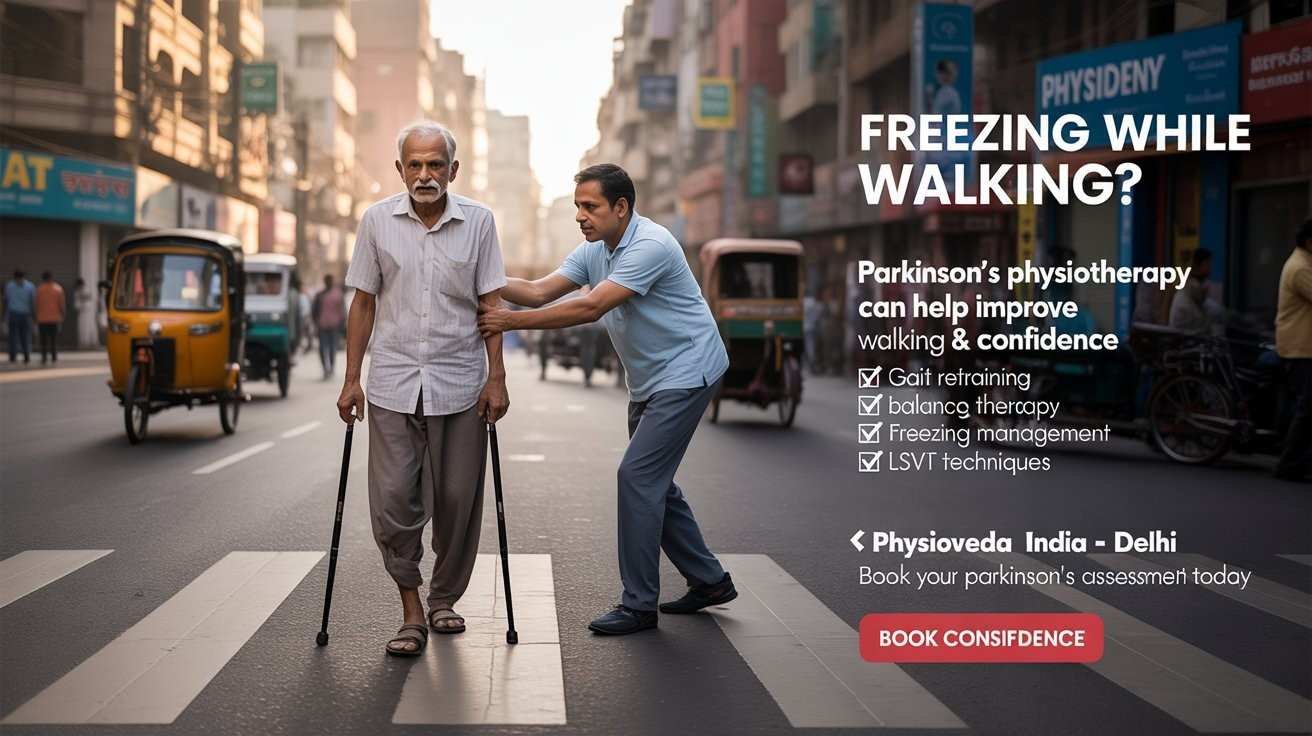
Walking difficulties are a hallmark of Parkinson’s. Our gait training focuses on retraining the walking pattern step by step:
- Step length and foot placement: We cue patients to take larger steps with a clear heel strike-toe-off roll. For example, we use visual targets on the floor or foot-landing lines so the patient makes each step fully, rather than flat-footed or tiny steps.
- Arm swing: Parkinson’s often causes arm swing to diminish. We actively cue patients to swing both arms in opposition to the legs, which naturally helps balance and forward momentum.
- Rhythm and timing: We use metronomes or music to establish a steady beat. Walking to a rhythm helps restore a natural stride cadence.
- Turning and directional changes: We practice safe turning strategies – e.g. stepping around in a wide circle instead of pivoting – to reduce the abrupt breakdown of balance. We train patients to look in the direction of the turn and take multiple small steps to execute a turn, which greatly reduces freezing.
- Walking speed and endurance: We gradually increase walking speed and duration. Treadmill training (often with body-weight support when needed) can safely boost walking speed and distance. In fact, treadmill-based rehab “can be expected to result in improvements in gait speed, stride length, and walking distance”.
- Dual-task practice: Once basic walking improves, we introduce cognitive challenges (like counting backward) or carrying light objects while walking. Training under these dual-task conditions improves the patient’s ability to walk safely in real-world scenarios (as research shows dual-task training can improve gait velocity and step length).
The combination of these techniques – emphasis on full steps, full arm swings, and steady rhythm – helps patients break free of the default Parkinsonian gait. Over weeks of training, even an initially shuffling gait can become faster, smoother, and more stable.
Freezing of Gait Management – Proven Cueing Strategies
Freezing is when the feet feel “glued” during walking. To tackle this, we use external and internal cues that essentially kick-start movement:
- Visual cues: Simple tricks like taping stripes on the floor or using a laser pointer mounted on a cane give a visual target to step to. For instance, stepping over an imaginary line on the floor can break the freeze. We might practice walking to foot-targets, which trains the brain to initiate stepping more easily. Evidence reviews show visual cueing is an effective intervention for freezing episodes.
- Auditory cues: Counting beats or using a metronome/audio rhythm can provide timing cues. We often have patients count “1-2-3…” out loud as they step, or walk to a recorded metronome or music with a clear beat. This pacing helps maintain a regular cadence and prevents halting. Studies consistently find auditory cueing increases step length and speed.
- Amplitude (“Think BIG”): We emphasize taking large, exaggerated movements – big steps, wide arm swings, tall upright posture. This LSVT BIG principle of “think big” counteracts the Parkinson’s tendency to miniaturize movement. Even visualizing oneself moving with gusto can help.
- 4S Strategy: In a sudden freeze, we teach patients a mnemonic: Stop – Stand tall – Shift weight – Step big. Pause walking, straighten posture, shift weight side-to-side, then take one big deliberate step. This often unblocks the freeze.
- Clock turns: When turning, instead of spinning, imagine a large clock on the floor and step around its numbers (e.g. step to “3 o’clock” then “6 o’clock” rather than pivoting 180°).
- Cueing before triggers: We also teach pre-emptive cues. For example, as someone approaches a narrow doorway (a common freeze spot), they might begin marching in place or counting steps just before stepping through, to glide through the transition.
- Auditory singing or humming: Making a rhythmic sound (humming, singing “left-right”) can also pace walking.
By practicing these strategies at home and in clinic, patients learn a “toolbox” of tricks to override freezing. Over time these become automatic strategies to safely resume walking.
Balance Training and Fall Prevention
Falls are a serious risk in Parkinson’s. We incorporate progressive balance exercises to build confidence and resilience:
- Static balance: Standing drills such as tandem stance (one foot directly in front of the other) or single-leg stance (holding onto a rail as needed). We gradually reduce hand support as control improves.
- Dynamic balance: Walking exercises that involve changing directions, obstacle courses (stepping over small hurdles or cones), and movements like marching or turning in place. Even simple tasks like reaching out of base of support train balance.
- Reactive balance: We practice quick stepping reactions (like stepping to the side or backward in response to a gentle push or the therapist’s cue), so patients learn to catch themselves if they stumble.
- Obstacle negotiation: Training includes walking around furniture or through narrow passages. Patients practice sideways stepping or walking backwards when needed. This mimics real-life scenarios and builds adaptability.
- Confidence and fall recovery: We simulate minor trips or missteps in a controlled way, showing patients how to safely right themselves or reach out to prevent a fall. Knowing how to recover reduces fear.
- Functional tasks: Balance confidence grows as patients practice safe sit-to-stands, turning in small spaces (like kitchens), or stepping onto low curbs.
Consistent balance training is proven to improve postural control. For example, one systematic program (PD-WEBB) showed that targeted balance exercises significantly improve balance and quality of life, reducing falls. Parkinson’s experts note that exercise can ”improve gait and balance and reduce falls”. At Physioveda, every session includes fall-prevention education: clearing rugs, wearing proper shoes, using adaptive aids when needed (and training on those canes or walkers for safety).
Posture Correction for Physiotherapy for Parkinson's Disease Delhi
Physiotherapy for Parkinson’s Disease Delhi. Many Parkinson’s patients develop a stooped posture – chin poking forward, shoulders slumped, back rounded. This isn’t just cosmetic: a forward head causes neck pain and shallow breathing. We address this with:
- Thoracic extension exercises: For example, lying on a foam roller or over a gym ball to gently arch the back. Or standing “superman” exercises (retracting shoulder blades, lifting the chest).
- Chin tucks and neck alignment: Teaching patients to pull the head back over the shoulders to lengthen the neck.
- Strengthening back extensors: Exercises like prone “arms lift” or seated row motions to build the muscles that keep you upright.
- Stretching tight front muscles: Pectoral stretches (doorway stretch), hip flexor stretches, and chest-opening movements. As noted, “stooped posture makes the muscles in the front of your body less flexible and the muscles in the back of your body weaker”. Stretching those tight chest and hip flexor muscles counteracts the stoop.
- Posture training cues: We often use mirrors or proprioceptive feedback (like having the patient press their shoulder blades to the wall) so they learn what “straight” feels like.
- Breathing with posture: Coordinating deep inhales with extending the spine helps reinforce an upright posture.
Correcting posture not only reduces pain but also expands lung capacity and improves speech. Patients learn to incorporate upright posture cues into daily tasks, such as standing tall while cooking or dressing, which helps maintain these gains.
Strength Training, Flexibility, and Stiffness Management for Physiotherapy for Parkinson's Disease Delhi
Parkinson’s causes rigidity in muscles that we fight with exercise. Our program includes:
- Lower limb strengthening: We target hip extensors, quads, and glutes using functional exercises (e.g. sit-to-stand repetitions, step-ups, squats with support). Stronger legs help with walking and transfers. Studies show that progressive resistance training should be used especially when aiming to improve walking capacity.
- Core and trunk exercises: We strengthen the abdominal and back muscles through bridging, prone planks (as tolerated), and seated trunk rotations. A stable core supports better posture and balance.
- Upper body strengthening: Pull exercises and shoulder presses maintain arm swing and protect posture.
- Flexibility stretches: Daily stretching is crucial. Slow static stretches for hamstrings, calves, hip flexors, chest and shoulders improve range of motion. Research notes that flexibility exercises (done regularly) enhance function in daily activities. For example, calf stretches allow a better push-off during walking; chest stretches open the thorax for better breathing and posture.
- Rigidity reduction drills: We use gentle oscillatory movements and massage on stiff joints, plus large-amplitude rocking exercises to “loosen” rigidity. Yoga or Pilates-inspired movements (supported, if needed) are also helpful.
Overall, a combination of strength and stretching builds a more mobile, powerful body. In fact, current evidence highlights that aerobic and strength training in Parkinson’s “improve walking, posture and balance”. Our practice follows these principles: each plan includes weight or resistance training as tolerated, plus daily stretching, to maximize mobility and reduce stiffness.
Functional Training for Daily Life Activities
Physiotherapy for Parkinson’s Disease Delhi. We believe therapy must transfer to real-world tasks. Therefore, we practice activities patients face every day:
- Bed mobility: Rolling in bed and sitting up using leg pushes or one elbow to practice changing positions safely in the morning.
- Chair transfers: Repeated sit-to-stand exercises (often with timed or weighted practice) make getting up easier. We teach pushing up from armrests and moving the center of mass forward.
- Kitchen/home navigation: Simulating cooking or laundry tasks, e.g. reaching up high, turning around safely in a narrow space, stepping sideways. We work on turning with minimal pivot (step-turn) to avoid freezing in places like the kitchen.
- Outdoor walking: We train outside around Delhi parks or on sidewalks to adapt to uneven ground, inclines, and crowds. Skills include scanning for obstacles, adjusting stride length as needed, and using steps one at a time or two at a time safely.
- Stairs: With safe handles, we practice ascending and descending stairs step-over-step, and also the safer method of stepping up with one foot and bringing the other to meet it (if needed).
- Dressing: While not strictly physiotherapy, we guide on efficient dressing techniques (e.g. sitting for shoes, adaptive buttons/velcro) to maintain independence. The big movements from LSVT BIG training can actually make dressing faster.
- Bathroom transfers: Practicing sit-to-stand from low seats and turning transfers onto the toilet safely. We may use grab bars or a raised toilet seat in training.
- General mobility tasks: Reaching down to pick up objects, carrying light objects while walking, and even simulated grocery shopping tasks help build automatic balance responses.
The goal is to ensure that improvement in the clinic means improvement at home. We see patients gain confidence to do things like cook a meal or take a short neighborhood walk without freezing or falling, because we have trained those exact skills.
Breathing, Chest Mobility & Endurance Training for Physiotherapy for Parkinson's Disease Delhi
Parkinson’s often causes a tight chest and shallow breathing. We address this with:
- Breathing exercises: We teach diaphragmatic breathing and chest expansion drills. For example, inhaling deeply while extending the spine or hugging arms around a ribcage and breathing into a towel held between the hands. This combats the stooped posture’s effect on breathing. Inspiratory muscle training (breathing against gentle resistance) is also used. In studies, inspiratory training improves lung function and thoracic mobility in PD patients.
- Thoracic mobility: Gentle twists and back extensions (e.g. standing rotation with arms wide) to make the upper spine more flexible. This directly facilitates deeper breaths and better vocal projection.
- Cardio endurance: We include moderate-intensity aerobic activities like brisk walking, cycling, or treadmill. The APTA guidelines strongly recommend moderate-high intensity aerobic exercise to improve overall function in PD. We build up endurance gradually – for example, increasing walking time on the treadmill or performing repeated walking circuits in the gym.
- Fatigue management: By improving cardiovascular endurance, patients can walk further without tiring. We also coach pacing strategies (rest breaks) and energy conservation.
Combining posture and breathing work ensures patients not only walk better but also breathe easier, which reduces fatigue. Over months of training, we often see patients walk longer distances without needing to sit.
Advanced Physiotherapy for Parkinson's Disease Delhi
At Physioveda Delhi, we integrate evidence-based, cutting-edge techniques into all therapy:
- LSVT BIG: An internationally recognized program focusing on large-amplitude movements. Our certified therapists deliver LSVT BIG exercises, which train patients to think big and move with normal-sized steps. This program is shown to recalibrate the brain’s sense of movement size, often leading to lasting improvements in walking speed and daily tasks (patients report doing things like dressing much faster).
- Cueing and attentional strategies: As above, we tailor external (visual/auditory) and internal cues to each person’s needs, so patients have strategies for any freezing or hesitations.
- Neuroplasticity-driven practice: We structure therapy to reinforce neuroplastic changes. This means high-repetition, task-specific practice of goal activities. For example, a patient’s specific goal (like walking to the garden and back) becomes a repetitive training task. This kind of practice helps the brain form new movement patterns.
- Combination therapy: We may combine techniques in one session – e.g. gait training with rhythmic music (melody + movement = music-based movement therapy) to maximize carry-over to function.
- Home programs and caregiver training: We give customized home exercise plans so gains continue outside the clinic. We also educate family on how to cue and assist safely.
These advanced approaches follow current guidelines recommending Parkinson’s-specific interventions: “gait training, external cueing, balance training, resistance training, [and] aerobic exercise”. At Physioveda we carry out such multimodal, progressive programs, making us a leading Parkinson’s rehabilitation center in Delhi. Physiotherapy for Parkinson’s Disease Delhi.
What Can Physiotherapy for Parkinson Disease in Delhi Actually Improve?
Physiotherapy for Parkinson’s Disease Delhi. Patients often see real functional benefits from our rehab, measured in day-to-day terms:
- Walking longer distances without needing a rest. (Our treadmill and community-based training boost endurance.)
- Fewer freezing episodes. With practiced cues, many report freezing up to 30–50% less often.
- Greater balance stability. Patients stand more steadily and have fewer near-falls. Research confirms that balance training can improve postural control in PD.
- Easier turning and transfers. We consistently see quicker, smoother turns (no longer a freeze trigger) and faster sit-to-stand times.
- Faster sit-to-stand and rise times. Strengthening exercises translate to less effort getting out of chairs and beds.
- Improved posture. Most patients hold themselves more upright, so they breathe better and walk with shoulders back, often after only a few weeks of postural exercises.
- Less stiffness. Regular stretching and movement reduce muscle tightness and make daily tasks feel less effortful.
- Boosted confidence and mood. Knowing they can move safely again often lifts fear and improves self-efficacy.
- Increased independence. Simple chores (dressing, cooking) take less time and effort, thanks to the combined effect of big movements and better balance.
These are all goals we track with patients. In fact, a meta-review notes that cueing interventions in PD consistently “improved gait parameters” (e.g. step length). Our patients’ success stories reflect longer walks, steadier steps, and more active days.
Best Time to Start Physiotherapy for Parkinson's Disease Delhi
As early as possible. Waiting only lets the unhelpful movement habits and weakness become entrenched. Parkinson’s experts and guidelines stress early rehab: “You don’t need to wait until you are having trouble moving to start [physical therapy]”. Starting PT soon after diagnosis can slow decline, prevent deconditioning, and build strength/balance reserve. Early therapy also builds habits of exercise before fear of falling sets in.
Delaying treatment tends to mean more falls, more muscle loss, and a cycle of fear that’s harder to break later. In contrast, we routinely see patients who start early maintain function much better long-term. Even very soon after diagnosis, a structured exercise program can have a neuroprotective effect and improve quality of life. In short, don’t wait – beginning physiotherapy at the first signs of Parkinson’s keeps you moving stronger for years to come.
Why Choose Physioveda for Physiotherapy for Parkinson Disease in Delhi
Choosing the right clinic makes a big difference. At Physioveda:
- Experienced specialist team: Our clinicians have over 12 years of neurologic rehabilitation experience, and have worked extensively with Parkinson’s patients. We truly understand Parkinson’s – its freezing, shuffling, and fear – because we see it every day.
- Detailed personalized assessment: We take extra time on the first visit for our comprehensive evaluation (as noted above). This ensures every treatment plan targets your specific deficits and goals.
- Advanced gait & cue training: We are among the few Delhi centers certified in LSVT BIG and other international PD programs. We combine these with proven cueing strategies to overcome freezing and festination.
- Holistic approach: Beyond exercises, we address posture, breathing, endurance and daily function. We involve family by teaching them how to safely assist and cue at home.
- Real functional focus: We aim for practical gains – walking farther in your neighborhood, turning in the kitchen, climbing stairs – not just doing abstract exercises. Our goal is your independence.
- Measurable progress: We frequently re-test walking speed, balance scores, and sit-to-stand time so you can see real improvements and stay motivated.
- Immediate relief and confidence: Many patients report noticeable ease of movement and less stiffness even during the first session, along with a boost in confidence. This early success builds momentum for the rest of rehab.
- Personalized care and empathy: As clinicians, we speak your language (one of us is Hindi-speaking) and understand Delhi life. We listen to your story and fears, and make therapy warm and supportive, not robotic.
- Indian-context care: We adapt techniques to daily life here – like training with dabbas on a head or practicing walking in crowds at local markets – so improvements truly carry over.
- Evidence-based treatment: All our methods align with the latest research on PD rehabilitation. We keep updating our protocols with global best practices.
- Home program and education: You leave each session with a safe home exercise plan and tips. We may visit you at home to ensure you can safely carry on exercises, or train a caregiver in simple cueing techniques.
In summary, Physioveda offers the best physiotherapy for Parkinson disease in Delhi because of our expert, hands-on care and proven results. We focus on your mobility and quality of life, using advanced methods, from the moment you walk in.
Simple Home Tips for Physiotherapy for Parkinson's Disease Delhi
Physiotherapy for Parkinson’s Disease Delhi. Even between sessions, these safe tips can help manage symptoms:
- Move every 30 minutes: Set alarms to remind yourself to stand, stretch, or march in place during long sitting (e.g. while watching TV). A quick 5–10 minute walk around the room or gentle calf raises by the chair can break up stiffness.
- Use visible step cues: Place strips of colorful tape or a brightly colored mat on the floor in narrow doorways or before a step. Stepping over them intentionally helps re-start walking when you feel frozen.
- March or rock before moving: When starting to walk or after freezing, try marching in place or shifting weight forward and back for a few counts before taking your first step. A gentle side-to-side sway can “warm up” your balance.
- Count or sing: Silent or out-loud counting (e.g. “one–two–three”) as you step can pace your walking. If you know the tune to a favorite song, quietly humming it can also create a natural rhythm to step to.
- Adopt wide turns: When turning, imagine walking around a large clock rather than spinning on the spot. Take a series of small steps around 360° rather than pivoting all at once.
- Practice posture and breathing: Throughout the day, remind yourself to sit/stand tall. Take a few deep belly breaths with arms lifted or clasped behind your back to expand the chest.
- Use assistive devices wisely: If using a cane or walker, ensure it’s adjusted to the right height and that you place it slightly ahead (not too far) before stepping. A forward-walking cane provides a steady visual and physical support.
- Declutter your path: Keep floors clear of rugs or clutter. Arrange furniture so hallways are wide, and there’s a continuous straight path – this reduces the chance of freezing in tight spots.
- Wear good shoes: Shoes with thin, nonslip soles and firm support can make each step more predictable. Avoid slippery or unstable slippers around the house.
Always keep safety first: if a freeze or fall is likely, slow down, hold onto rails/furniture, or ask for a steadying hand from a family member.